Best Time to Visit Timanfaya: Month by Month, Crowds and Time of Day
Timanfaya weather this week
Islote de Hilario
The five-day forecast for Islote de Hilario, updated through the day.
Forecast data from MET Norway (CC BY 4.0), summarised by day.
There is no bad month for Timanfaya. Lanzarote is dry and mild all year, the Montañas del Fuego open every day, and the Volcano Route runs whatever the season. If you can choose, spring (March to May) and autumn (October and November) give the most comfortable mix of warmth, sunshine and moderate crowds; July and August are the hottest and busiest; and December is the wettest month, though even then rain is brief and light. Within any day, the first slots of the morning and the mid-afternoon slots are the easiest, and since timed tickets arrived the old queues at the entrance have largely gone.
This guide sets out the climate month by month, how busy the park gets and when, the best time of day for each part of a visit, and how the season changes what to wear and what else to do nearby. For today’s forecast, see the Timanfaya weather page.
The short answer
- Best overall: March to May and October to November. Warm days, plenty of sun, fewer people than in high summer.
- Hottest and busiest: July and August. The ground and the air are hot, there is no shade in the park, and visitor numbers rise.
- Wettest: December, with about 29 mm of rain spread over a handful of days. That is still very little.
- Best time of day: an early slot, from 09:00, or a mid-afternoon slot. Late morning tends to be the busiest part of the day.
- Always: book your timed ticket online before you drive. Tickets are only sold online, for a fixed date and time.
Timanfaya’s climate in numbers
The nearest long-term weather record is the station at Lanzarote Airport, run by AEMET, Spain’s state meteorological agency. Its climate normals cover 1981–2010 at an altitude of 14 m. Islote de Hilario, where the visit starts, sits at about 404 m, so expect it to be a little cooler and noticeably windier than these figures, but the pattern through the year is the same.
| Month | Average high | Average low | Rain | Rain days | Hours of sun |
|---|---|---|---|---|---|
| January | 20.7 °C | 14.0 °C | 16 mm | 3.2 | 203 |
| February | 21.3 °C | 14.3 °C | 18 mm | 2.7 | 201 |
| March | 22.9 °C | 15.0 °C | 12 mm | 2.4 | 241 |
| April | 23.5 °C | 15.7 °C | 5 mm | 1.3 | 255 |
| May | 24.6 °C | 16.8 °C | 2 mm | 0.4 | 297 |
| June | 26.3 °C | 18.8 °C | 0 mm | 0 | 292 |
| July | 28.2 °C | 20.4 °C | 0 mm | 0 | 308 |
| August | 29.1 °C | 21.2 °C | 0 mm | 0.1 | 295 |
| September | 28.6 °C | 20.8 °C | 2 mm | 0.4 | 248 |
| October | 26.7 °C | 19.4 °C | 10 mm | 1.9 | 235 |
| November | 24.2 °C | 17.2 °C | 15 mm | 3.0 | 207 |
| December | 21.8 °C | 15.4 °C | 29 mm | 3.8 | 196 |
Rain days are days with at least 1 mm. Over a whole year the station records only 111 mm of rain on about 19.0 days, and 2,986 hours of sunshine. In other words, the weather will almost never stop a visit; what changes through the year is heat, wind and light.
Month by month
January and February
The coolest months, with average highs of 20.7 °C in January and 21.3 °C in February at the coast, and lows of about 14 °C. Rain is possible but usually comes as short showers. At Islote de Hilario the wind can make it feel chilly, especially on the open terrace by the geothermal demonstrations. These are good months for walking in the volcano country around the park. Book your slot a few days ahead if your dates are fixed.
March to May
Many people’s favourite season. Highs climb from 22.9 °C in March to 24.6 °C in May, rain all but disappears by May (2 mm on average), and sunshine rises to 297 hours in May. The light is clear, the air is not yet hot, and the lava fields are comfortable to look at from the bus and on foot. Outside the school holidays, spring is one of the calmer times to visit.
June to September
The hot, dry season. Average highs run from 26.3 °C in June to 29.1 °C in August, the warmest month, and there is essentially no rain from June to August. July is the sunniest month, with 308 hours of sun. The park has nowhere to shelter from the sun and no picnic areas, and the black and red ground absorbs heat, so the middle of the day can be tiring, especially for children. This is also the busiest period: the company that runs the centres expects average visitor numbers to rise considerably in July and August. If you visit in summer, take an early slot and plan the afternoon at the beach.
October to December
Autumn is warm (highs of 26.7 °C in October, 24.2 °C in November) and quieter than summer. Rain returns slowly: about 10 mm in October, 15 mm in November and 29 mm in December, the wettest month and the one with the fewest hours of sun (196). Even in December most days are dry. From October the wind becomes more noticeable on the high ground, and CACT recommends warm clothing at the Montañas del Fuego from October to April.
How busy Timanfaya gets
Timanfaya is one of Lanzarote’s most visited sights. The national park receives more than half a million visitors a year, and the Montañas del Fuego, where the bus tour starts, was the busiest of all the island’s art, culture and tourism centres in 2023, with 921,343 visitors. Across all the centres, CACT counted 2,956,406 visitors in 2025.
For years the result was long queues of cars on the LZ-67 waiting to get into the Montañas del Fuego, especially in summer. That changed in 2026:
- Timed online booking. Since 5 June 2026 entry has worked by online booking with a set time slot, first as a trial. In July 2026 the CACT chief executive said that no day had seen queues under the new system.
- Online only. Tickets for the Montañas del Fuego are only sold online, always for a specific date and time.
- Tour coaches unchanged. Access for tour coaches has not changed, so organised tours still arrive in waves.
- Summer still busier. CACT expects the timed system to cope with July and August, the months when visitor numbers rise most.
The practical lesson: the crowd you meet at Islote de Hilario now depends more on the slot you book than on the day. A full slot still means a full bus, but you will not spend an hour in a line of cars before you get there.
The best time of day
Opening hours
CACT lists the Montañas del Fuego visit as 09:00–15:45 every day, which are the times of the bookable slots. The park’s own website lists the centre itself as open 9:00 to 17:00, Monday to Sunday, which covers the time needed to finish the last visits. CACT puts the whole visit at about 1 hour and 15 minutes, and the bus route itself at about 35 minutes.
Which slot to book
- First slots (from 09:00). The coolest, calmest part of the day, with low, raking light that brings out the colours of the craters. Ideal in summer and with children.
- Late morning. The time that suits most people driving from the resorts and most organised tours, so expect a fuller car park and a busier terrace.
- Mid-afternoon (up to 15:45). Usually quieter, as most tours move on to the rest of the island. The light softens later in the afternoon, and you can head on to the west coast for sunset.
Whatever you book, arrive at the ticket office 15 minutes before your slot. Once your booked time has passed, access cannot be guaranteed.
Lunch at El Diablo
The El Diablo restaurant at Islote de Hilario does not take reservations; tables go first come, first served. If you want to eat there, an early slot followed by an early lunch, or a late lunch after a midday slot, avoids the busiest moment.
The camels and the visitor centre
- Camel rides at the Echadero de los Camellos run from 9:00 to 15:00 every day except 25 December and 1 January. Go early in summer, before the heat builds.
- The Mancha Blanca visitor centre opens daily from 9:00 to 16:00. It is a good first stop on a cool or windy morning, before your Montañas del Fuego slot.
More on both in our guide to the walks, camels and visitor centre.
What the season means for what you wear
Timanfaya’s weather is predictable, but the high, open ground exaggerates both sun and wind.
- June to September: CACT advises a cap or sun protection. The park adds sunglasses and high-factor sun cream, as there is no shade anywhere in the visitor area.
- October to April: CACT recommends warm clothing, because the Montañas del Fuego is a windy area. A light windproof layer is enough most days.
- All year: comfortable shoes, water and some food. The park asks visitors always to carry water or other drinks.
Planning around the timed slots
Because the system is online and timed, the best time to visit is partly the best time to book:
- Book before you set off. Tickets cannot be bought at the gate, and there are no changes or refunds once booked.
- One booking, one group. A booking gives a single QR code for everyone, so the whole group enters together.
- Allow for the drive. From the El Taro entrance you must stay in your vehicle all the way to Islote de Hilario, so build in time for the approach road.
- Price. A ticket costs €30 for adults, €15 for children aged 7 to 12, and nothing for under-7s.
Our ticket and Volcano Route guide explains every step of the visit, and getting to Timanfaya covers the roads and parking.
The Insólita Experience: an early, small-group option
If you want a quieter visit, CACT runs the Insólita Experience, a guided small-group visit that starts at 08:45 on Mondays, Wednesdays and Saturdays, lasts 120 minutes and costs €59.90. It begins before the main flow of visitors and includes stops not open on the standard ticket. If those days fit your plans, it is the surest way to see the park before the crowds.
The best time for photographs
You cannot stop or get out of the car between El Taro and Islote de Hilario, and you may not get off the bus on the Volcano Route, so most photographs are taken at Islote de Hilario or through the bus window.
- Early and late slots give the best light on the craters. Around midday the sun flattens the colours.
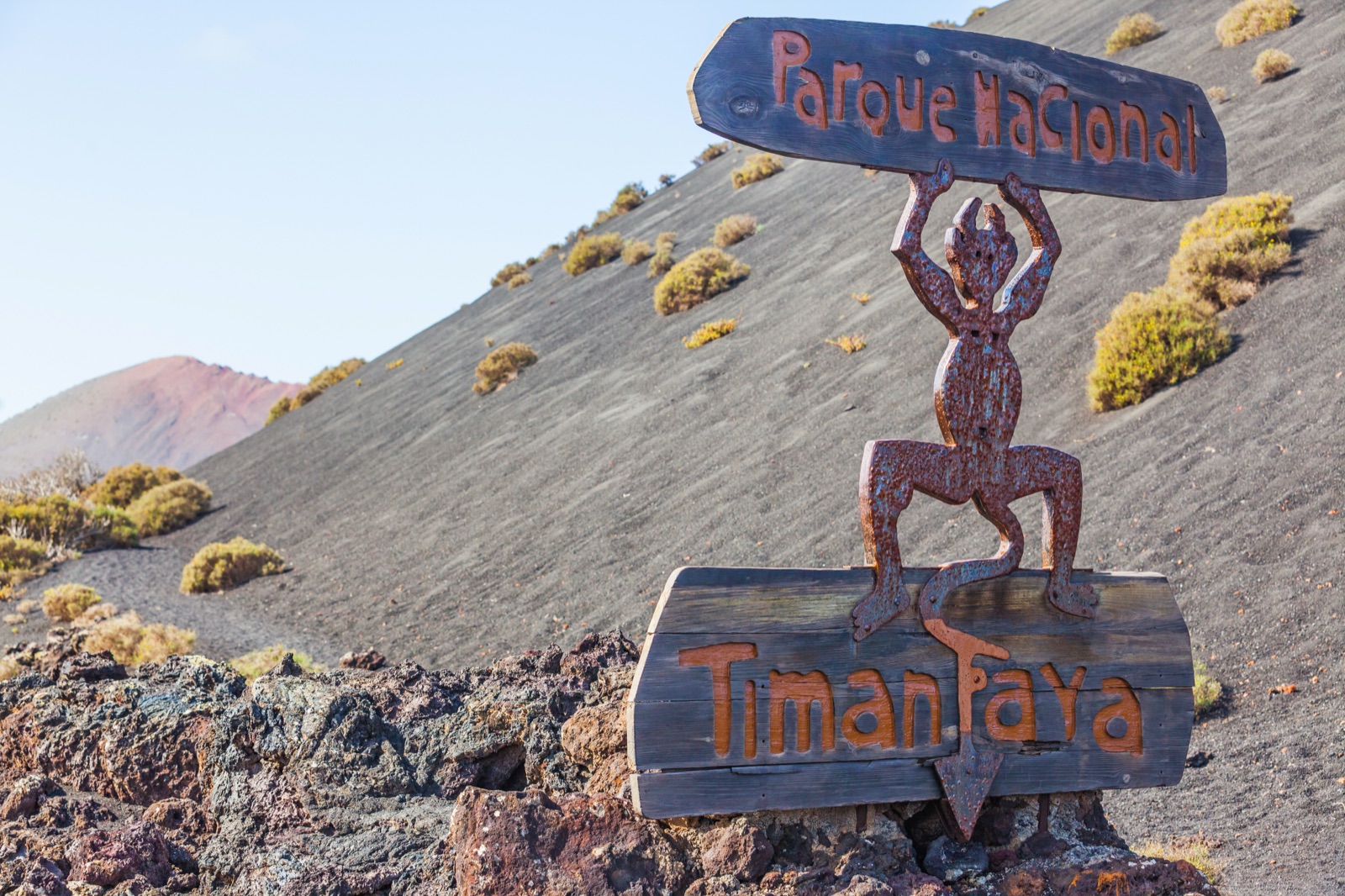
- At Islote de Hilario, CACT suggests photographing the geyser area, the natural oven, the Devil figure and the Route of the Volcanoes.
- Sit on the side away from the sun on the bus to cut reflections on the glass.
- For sunset, leave the park in the afternoon and drive to the west coast. The tourism board suggests El Golfo in the last hours of the day and the Salinas de Janubio at sunset. See our article on El Golfo and Los Hervideros.
The best time for walking
Walking in the national park itself is limited to the park’s free guided routes, which must be booked at least a month in advance. The Tremesana route takes about 3 hours over 3.5 km. In summer, choose the earliest walks you can.
Next door, in the Parque Natural de Los Volcanes, the waymarked trails around Caldera Blanca, Caldera de los Cuervos and Montaña Colorada are open all year without a ticket. The tourism board lists the Caldera Blanca route as suitable all year, but in July and August start early and carry plenty of water. Our guide to Caldera Blanca and the free volcano walks has the details.
The best time for the wine country
La Geria, the volcanic vineyard landscape just east of the park, changes with the season:
- August and September are the grape harvest, when the vineyards are busiest.
- November brings Semana Malvasía, the island’s wine week, which in 2026 ran from 3 to 8 November.
- Spring is green and mild, good for driving the LZ-30 and stopping at wineries.
See La Geria: Lanzarote’s volcanic wine country for the wineries and tastings.
The best time with children
With young children, the season matters less than the hour. The first slots of the day are cooler and calmer, the camel rides are pleasanter before the heat builds, and a short morning leaves the afternoon for the beach. Our guide to Timanfaya with kids and accessibility covers prices, pushchairs and what suits each age.
A sample day in each season
Summer (June to September)
- 09:00 slot at the Montañas del Fuego, with the geothermal demonstrations and the bus.
- Camel ride at the Echadero on the way out, before the heat builds.
- Lunch in Yaiza or El Golfo, then an afternoon on the beach.
Spring and autumn
- Mancha Blanca visitor centre first thing (opens 9:00).
- Late-morning slot at the Montañas del Fuego and lunch at El Diablo.
- A short trail such as Montaña Colorada in the afternoon, or the wineries of La Geria.
Winter (December to February)
- Mid-morning slot, once the air has warmed a little, with a windproof layer.
- Afternoon on the west coast at Los Hervideros, which is most spectacular when the sea is rough.
- Sunset at El Golfo or the Salinas de Janubio.
If you would rather not drive, several tours from the resorts include the Montañas del Fuego and run all year, with hotel pick-ups and the timing taken care of.
Frequently asked questions
What is the best month to visit Timanfaya?
March to May and October to November balance warmth, sunshine and crowds best. There is no bad month: even December, the wettest, averages only 29 mm of rain.
Is Timanfaya open all year?
Yes. The Montañas del Fuego open every day, and the CACT centres open 365 days a year. The camel rides run every day except 25 December and 1 January.
Is it too hot in summer?
It is hot rather than dangerous. August averages 29.1 °C at the coast, and there is no shade in the park. Take an early slot, a cap and water, and you will be fine.
Are there still queues?
Much less than before. Since timed online tickets started on 5 June 2026, CACT has reported no queues. Access for tour coaches has not changed, so expect the busiest moments in the middle of the day.
What time should I arrive?
At the ticket office 15 minutes before your booked slot. Once your time has passed, entry cannot be guaranteed.
Does it rain at Timanfaya?
Rarely. The airport station records 111 mm a year on about 19.0 days, mostly between November and February.
Is the wind a problem?
It can be chilly at Islote de Hilario, especially from October to April, when CACT recommends warm clothing.